
12
2026
How you can easily perform a COF test for package materials?
 An article by admin

We understand that ensuring your packaging materials have the correct slip properties is critical for efficient production line performance and product safety. A Coefficient of Friction (COF) test provides the data you need to prevent issues like film jamming or unstable stacking. This guide will walk you through the straightforward process of performing this essential test. Our aim is to equip you with the knowledge to confidently measure and interpret COF values for your materials.

COF Test Preparation Steps
Proper preparation is fundamental for obtaining accurate and repeatable COF results. First, you must condition your film samples in a controlled atmosphere, typically 23±2°C and 50±5% relative humidity, for no less than 16 hours to standardize their moisture content and temperature. Next, carefully cut your test specimens to the specified dimensions, ensuring they are free from scratches, wrinkles, or any contamination that could skew the data. You will need two types of specimens: one to be mounted on the sled and another, larger piece, to be fastened securely onto the horizontal test platform. The use of a calibrated coefficient of friction tester is required, and you must verify its level and that all moving parts operate smoothly before initiating the test procedure to ensure procedural integrity.
COF Measurement Device Operation
Operating the testing instrument requires methodical attention to detail. Begin by securing your prepared film specimen flat and wrinkle-free onto the test bed. Attach the sled, which is covered with a second piece of the test film or a standard reference material, and place it onto the bed’s surface. Ensure the sled is connected to the force measurement system. Initiate the test via the control interface; the machine will then mechanically pull the sled across the flat specimen at a constant, specified speed. The internal sensor continuously records the force required to initiate and maintain this movement. This data is processed by the system’s software to calculate both static and kinetic COF values. The procedures followed by Labthink and other manufacturers are designed to be user-friendly, guiding you through this standardized process for reliable data acquisition.
COF Result Interpretation Guide
Interpreting your COF results correctly is key to making informed decisions about your packaging film’s performance. The test yields two primary values: the static coefficient of friction, which measures the force needed to initiate movement, and the kinetic coefficient, which measures the force to sustain movement. A low static COF is often desirable for easy opening of bags, while a specific kinetic COF range is crucial for preventing slippage on conveyor belts or in stacked packages. Compare your results against your internal specifications or relevant industry standards to determine if the film is suitable for its intended application. Consistently high or variable results may indicate issues with film formulation or processing conditions that need addressing before full-scale production.
Conclusion
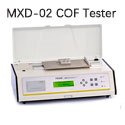
We provide instruments like the MXD-02 Coefficient of Friction Tester, which measures static and kinetic coefficients of friction. It is used on materials including plastic films, rubber, paper, fabrics, and coatings. Our tester conforms to standards such as ISO 8295, ASTM D1894, and GB 10006. This friction testing machine is a product of the company Labthink.


Leave a comment

Videos for Friction Tester
Recent Posts
- How a Coefficient of Friction Tester Functions: Understanding Its Role in Material Testing
- How to Ensure Long-Lasting Performance of Your Coefficient of Friction Tester
- Understanding the Various Friction Test Methods for Different Materials
- Labthink MXD-02 Coefficient of Friction Tester: Precision Testing for a Wide Range of Materials
- Understanding the Role of Friction Analysis in Material Testing